
Context
I did this research at the New York Institute of Technology over roughly a year. The goal was a passive radar system that improves aerial security: detecting an aircraft and estimating its position using signals that already fill the air, like cell towers and radio stations, instead of emitting its own.
I designed the simulations, built and trained the networks in MATLAB, and worked on the receiver design with a microwave engineer and a student at the University of Queensland. The results were published as a first-author paper at the 2019 IEEE Radar Conference in Toulon.
Constraints
- Simulation only: MATLAB with the Neural Network and Signal Processing toolboxes, no field measurements.
- The receiver had to be cheap enough to deploy widely.
- In an emergency there may only be seconds to stand a system up, so training time mattered as much as accuracy.
Problem
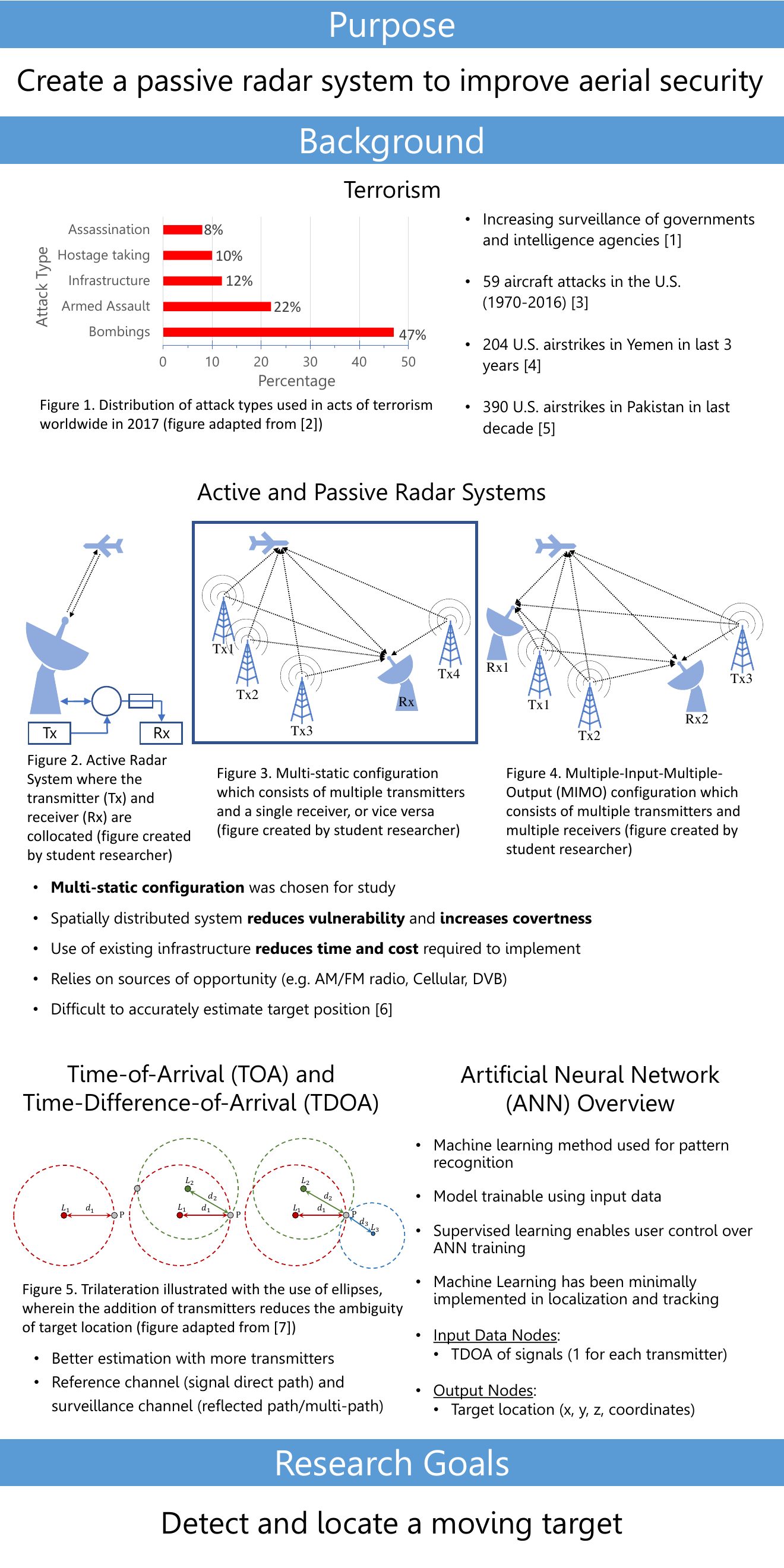
Aerial security matters and is expensive. Active radar, where a transmitter and receiver share an antenna, is powerful but costly and open to jamming and interference. Passive radar reuses existing infrastructure, which makes it low-cost and covert, but locating a target from the delay between a direct signal and its reflection is hard in noise.
The question was whether an artificial neural network could detect a target and estimate its location in a large 3D outdoor space, under heavy noise, better than existing localization methods.
North starLocalization error in meters as a function of signal-to-noise ratio.
Decisions
Passive multi-static over active radar or MIMO
- Options
- Active radar, passive MIMO, or passive multi-static.
- Evidence
- Active systems are costly and jammable. Multi-static needs only one receiver, where MIMO needs more.
- Chose
- One receiver and four transmitters of opportunity, using the time difference of arrival between direct and reflected signals, the same idea as trilateration in GPS.
- Didn't build
- An active radar system.
- Cost
- Accuracy depends on which transmitters happen to be nearby and how they're placed.
A small network over a deep one
- Options
- A deep neural network or a shallow one.
- Evidence
- In experiments the shallower network trained considerably faster and performed on par.
- Chose
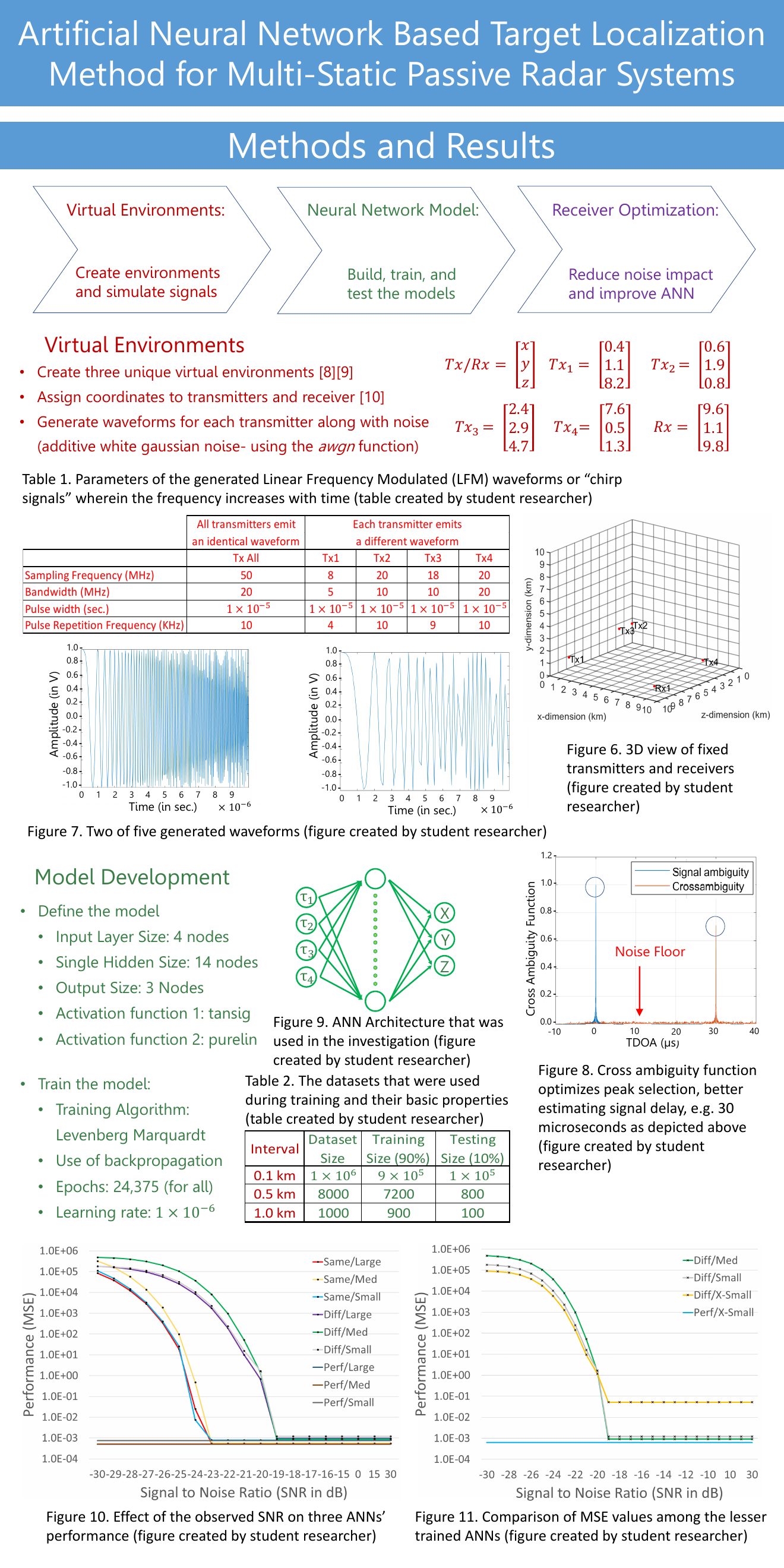
- Four input nodes (one per transmitter), 14 hidden nodes, three outputs (x, y, z), trained by backpropagation with the Levenberg–Marquardt algorithm.
- Didn't build
- A deeper architecture.
- Cost
- Less headroom if the problem grew, which was acceptable at this size.
Test the easy case and the realistic case
- Options
- One controlled setup, or a controlled one alongside a realistic one.
- Evidence
- Noise would hurt more in a realistic setting, so results from an idealized setup alone would overstate performance.
- Chose
- Three virtual environments, each 10 km on every axis with different grid intervals. Transmitters were placed at fixed, realistic (not equiangular) positions, and I ran two cases: all transmitters sending the same chirp signal, and each sending a different one. Error stayed under ±1 m in both, with the realistic case worse, as expected.
- Didn't build
- A single idealized benchmark.
- Cost
- More simulation work per result.
Trade accuracy for training time when seconds matter
- Options
- Train for best accuracy, or also train a network built to be ready fast.
- Evidence
- A network trained in under 10 seconds still localized to within ±100 m.
- Chose
- Keep both: the ±1 m network for accuracy, and a fast-training one for events where a system has to be up in seconds.
- Didn't build
- A single model tuned for one objective.
- Cost
- ±100 m is coarse, but better than no defense at all.
Solution
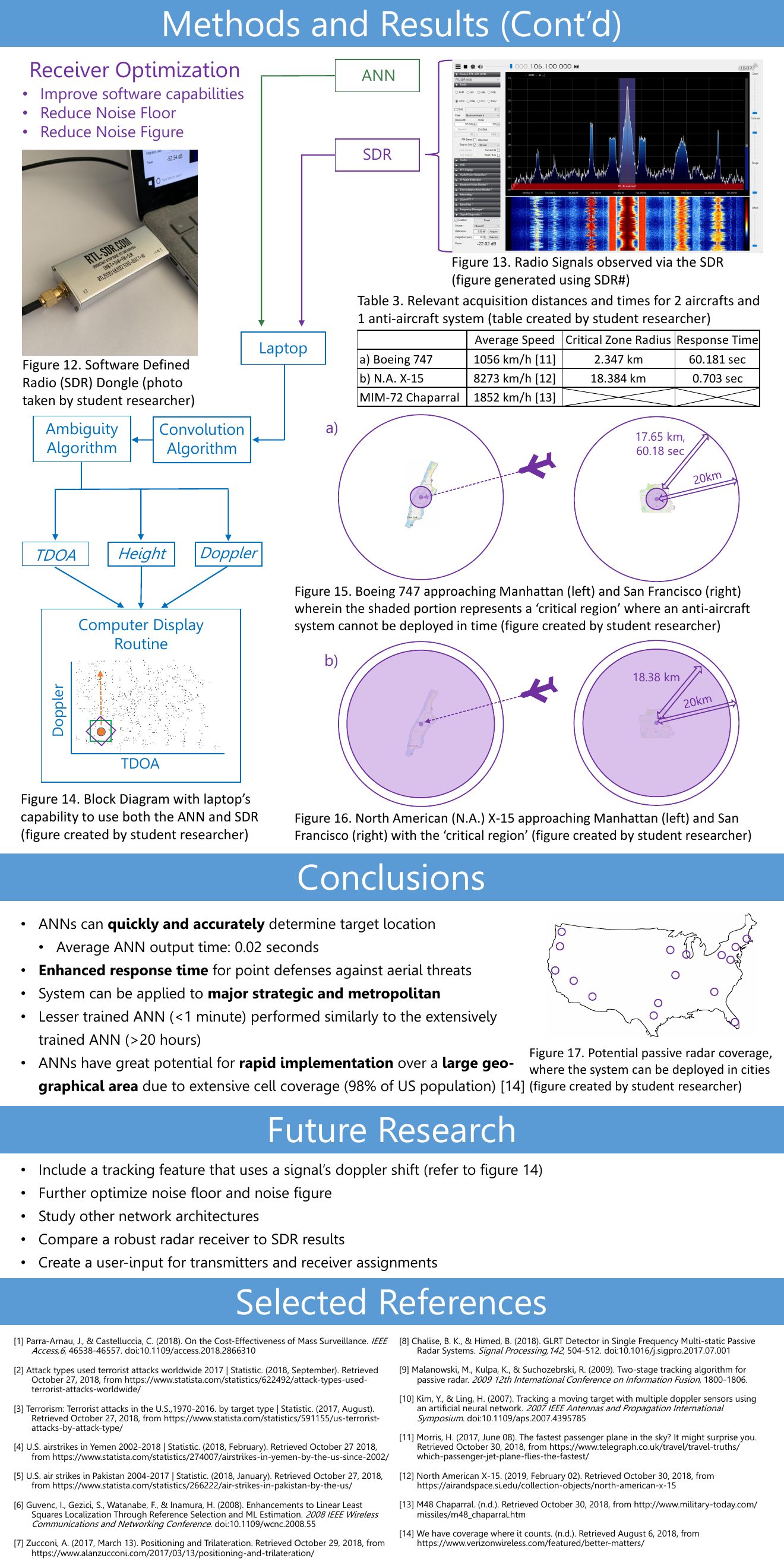
The work has three parts: virtual environments that generate time-difference-of-arrival values from chirp signals with a cross-ambiguity function, the 4-14-3 network trained on them, and a proposed receiver. Because a network is only as good as its input, I worked with an engineer to reduce the receiver's noise floor and noise figure, proposing a $20 software-defined radio that feeds the trained networks in local software for real-time tracking.
Outcome
In simulation, the network localized targets to within ±1 m down to −19 dB SNR, in both the controlled and realistic cases, and a network trained in under 10 seconds stayed within ±100 m. The paper was accepted at the 2019 IEEE Radar Conference (Toulon) with me as first author, and the project made me an Intel ISEF finalist.
All accuracy figures are from simulation. The software-defined-radio receiver was a proposal and was not built or validated in the field.
Do differently
- Compare against a classical localization baseline, so the gain from the network is a measured number rather than an assumption.
- Validate on recorded real-world signals, not only simulated ones.
- Prototype the $20 receiver, since the whole appeal of the system rests on it.